Our work is grounded in lived experience and informed by research into the barriers women face in sustaining workforce participation after displacement.
What the Research Shows
Key Insights from Our Research
Workforce entry alone does not lead to sustained employment outcomes
Unaddressed trauma directly impacts employment stability and long-term retention
Skilled and experienced women are often underutilized in host economies
Social and behavioural factors are critical to sustained workforce participation, yet are often overlooked
Women represent nearly 50% of the global refugee population, yet many remain underemployed or unable to sustain long-term employment in host countries.
(Source: UNHCR)
Workforce participation is often unstable, with many women experiencing cycles of employment and job loss due to unaddressed social and behavioural challenges.
These findings point to a critical gap—not in access to employment, but in sustained participation and long-term economic integration.
They highlight the limitations of existing approaches that focus primarily on entry into the workforce, without addressing the underlying factors that influence retention, progression, and stability.
The RebirthHer framework was developed in direct response to these gaps, providing a structured, trauma-informed pathway that supports women not only in accessing work, but in sustaining, progressing, and contributing meaningfully over the long term.
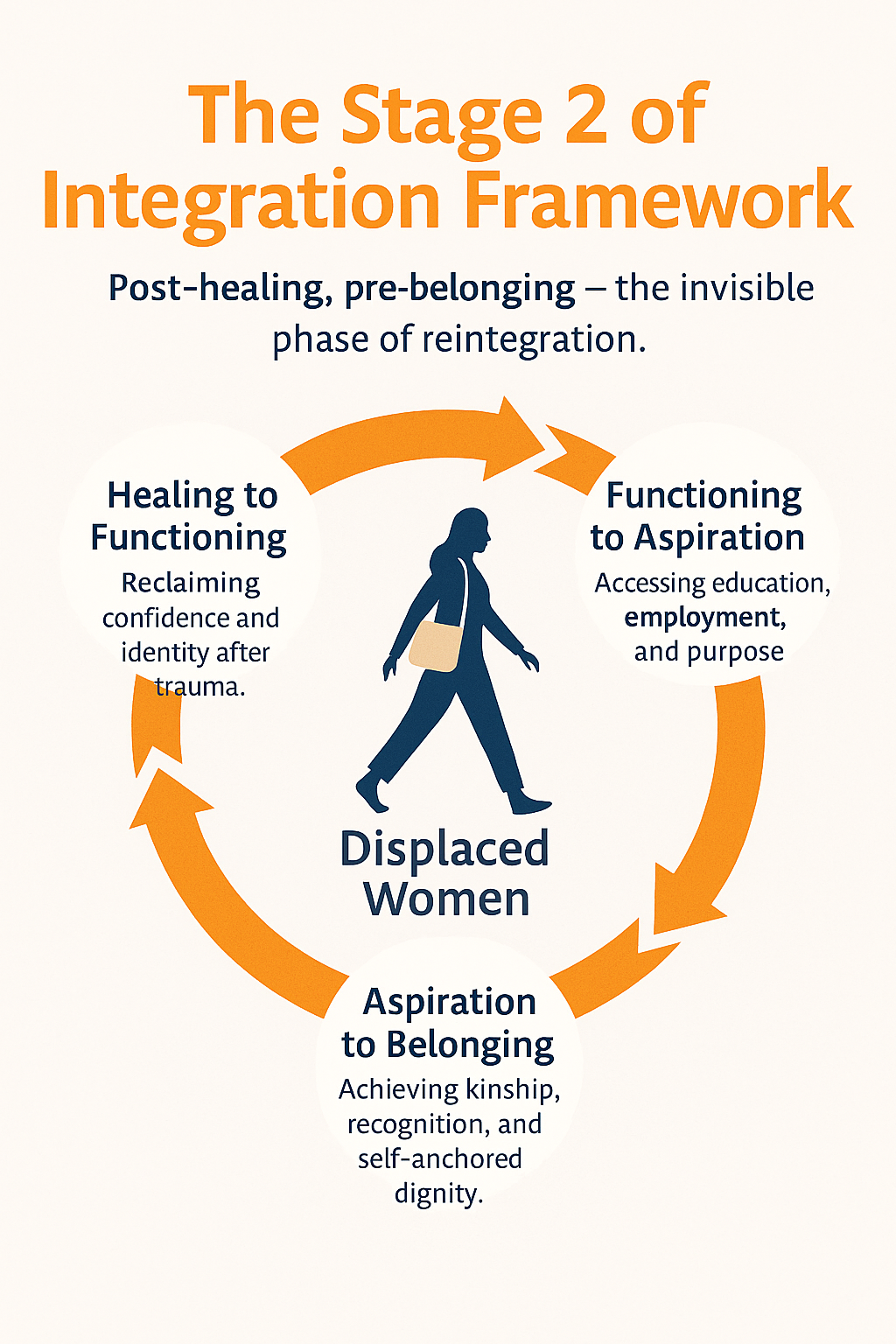
1. The Stage 2 of Integration Framework
Post-healing, pre-belonging — the invisible phase of reintegration. Our flagship model defines the Stage 2 of Integration as the period when displaced or refugee women have healed enough to re-engage with society but have not yet secured belonging.
This framework maps the emotional, social, and economic dimensions of this liminal phase — capturing the tensions between self-reclamation and social acceptance.
Healing to Functioning: reclaiming confidence and identity after trauma.
Functioning to Aspiration: accessing education, employment, and purpose.
Aspiration to Belonging: achieving kinship, recognition, and self-anchored dignity.
This framework now guides our research design, mentorship structures, and advocacy efforts.
2. The Kinship Model of Reintegration
Because no woman integrates alone. Our Kinship Model emphasizes that sustainable reintegration is relational — not individualistic.
It highlights the necessity of social rooting — forming trust circles, community bonds, and peer mentorship that bridge professional, emotional, and cultural gaps.
This model underpins our community programs, such as the RebirtHer Advisors Circle and our WhatsApp Kinship Space, ensuring that belonging is co-created, not prescribed.
3. Evidence into Practice
Every framework we build is tested through our programs and partnerships. Our research doesn’t end in publication — it continues in the stories, workplaces, and communities of women reclaiming their power after displacement.
Each insight, each framework, is a tool for systemic change.
4. Forthcoming Publications
The Stage 2 of Integration Report (2026)
Kinship in Diaspora: Building Belonging Beyond Borders
Policy Brief: Reframing Labor Integration for Displaced Women in Canada